The Distributed Compute Shift: How Edge Architecture Is Rewriting the Economics of Data Processing
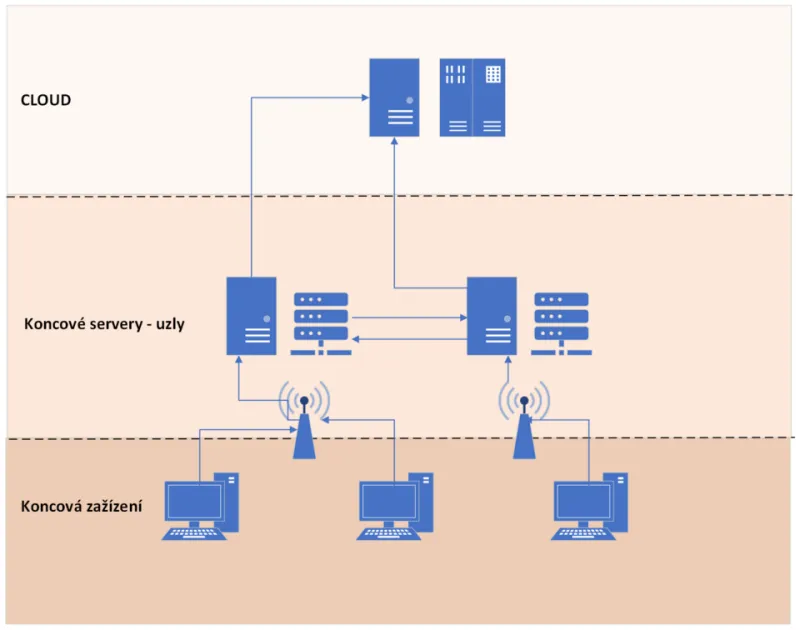
Photo: Psenda38, CC0, via Wikimedia Commons
The modern cloud infrastructure model was built on a straightforward premise: centralize compute, storage, and networking in large, efficiently operated facilities, then deliver services to end users over broadband connections. For most of the past two decades, that architecture served the industry well. Applications could tolerate the latency of a round trip to a regional data center. Bandwidth was the scarcer and more expensive resource. Centralization made economic sense.
That premise is now under structural pressure from multiple directions simultaneously. The emergence of latency-sensitive applications — autonomous systems, real-time inference pipelines, industrial automation, and immersive computing environments — has exposed a fundamental constraint of the centralized model: physics. The speed of light places a hard ceiling on how quickly a signal can travel from a sensor in a Detroit manufacturing plant to a cloud region in Virginia and return with a processed result. When that round trip must complete in under ten milliseconds, the centralized data center is not merely inconvenient. It is architecturally disqualified.
Edge computing is the industry's response to that constraint, and its implications extend well beyond latency optimization.
Unbundling the Data Center
The term "edge computing" encompasses a wide range of deployment patterns, from on-premises inference servers in hospital operating rooms to micro-data-centers installed at cellular base stations across rural US markets. What these deployments share is a common principle: push compute closer to the point where data originates, reducing the volume of raw information that must traverse wide-area networks and shrinking the response time between observation and action.
This architectural shift constitutes a meaningful disruption to the business model of hyperscale cloud providers — Amazon Web Services, Microsoft Azure, and Google Cloud — that have dominated enterprise infrastructure investment since the early 2010s. It does not eliminate the role of centralized cloud infrastructure; model training, large-scale analytics, and global data aggregation will continue to favor centralized environments for the foreseeable future. What it does is fragment the inference and real-time processing layer — historically a reliable and growing revenue stream for cloud providers — across a distributed fabric of edge nodes that may be operated by telecommunications companies, equipment manufacturers, or enterprises themselves.
Industry analysts tracking infrastructure spending in the US market have observed a measurable reallocation of capital toward edge deployment. Telecommunications carriers including AT&T and Verizon have positioned their multi-access edge computing (MEC) platforms as direct alternatives to cloud-region-hosted inference for mobile and IoT workloads. The pitch is straightforward: if the processing happens at the base station rather than in a distant data center, the latency drops by an order of magnitude and the bandwidth cost of transmitting raw sensor data over the core network is eliminated.
Sectors Leading the Architectural Transformation
Manufacturing is among the clearest early adopters of distributed inference architectures. US industrial facilities deploying computer vision systems for quality control and predictive maintenance cannot afford the latency variability introduced by cloud round trips on production lines operating at high throughput. Edge inference — running trained models on dedicated hardware installed within the facility — delivers the deterministic response times that industrial control systems require. Companies including Siemens and Rockwell Automation have built edge-native platforms targeting exactly this use case.
Healthcare presents a structurally similar argument. Medical imaging analysis, patient monitoring, and surgical assistance systems all involve scenarios in which latency and data sovereignty concerns make cloud-first architectures problematic. US regulatory frameworks governing the handling of protected health information add an additional compliance dimension that favors on-premises or private-edge deployments over public cloud processing.
Retail is a third sector experiencing meaningful architectural change. Large US retailers operating physical stores have begun deploying edge inference nodes to support inventory management, loss prevention, and customer analytics applications that require real-time video analysis. Transmitting continuous high-resolution video streams to a cloud region for processing is both bandwidth-intensive and economically inefficient at scale. Processing that inference locally and transmitting only structured metadata to centralized systems inverts the data flow in a way that reduces costs and improves response times simultaneously.
The New Bottlenecks: What Edge Architecture Does Not Solve
The migration toward edge compute does not eliminate infrastructure complexity — it redistributes it. Several new bottlenecks are emerging that the industry has not yet fully resolved.
Model management at scale represents one of the most acute operational challenges. A centralized cloud deployment requires maintaining and updating a model in one location. An edge deployment may involve thousands of discrete nodes distributed across retail locations, manufacturing sites, or vehicle fleets. Ensuring that each node is running a current, validated model version — and that failed updates can be detected and rolled back reliably — introduces a device management burden that many engineering teams are underestimating.
Hardware heterogeneity compounds this challenge. Edge inference hardware spans a wide spectrum, from NVIDIA Jetson modules and Intel Neural Compute Sticks to custom silicon developed by semiconductor startups. Models optimized for one hardware target may perform poorly or require significant re-engineering to run efficiently on another. The software abstraction layers that make cloud compute relatively hardware-agnostic do not yet exist in mature form for the edge environment.
Security and physical access present a third category of risk that centralized architectures largely sidestep. A server in a managed data center benefits from physical security controls, environmental monitoring, and network perimeter defenses that most edge deployment sites cannot replicate. An inference node installed in a retail environment or mounted on public infrastructure is physically accessible in ways that create attack surfaces that demand careful engineering attention.
Reading the Signal in the Infrastructure Shift
The edge computing transition is not a binary replacement of centralized cloud infrastructure. It is a functional decomposition — an unbundling of the monolithic data center into specialized processing tiers, each optimized for a different set of constraints. Centralized environments retain their advantage for workloads that benefit from massive compute aggregation: model training, global analytics, and applications without hard latency requirements. Edge environments capture workloads where physics, economics, or regulatory requirements make centralization untenable.
For computing infrastructure stakeholders in the US market, the signal worth monitoring is not which architecture wins, but how the boundary between these tiers evolves as edge hardware becomes more capable and edge orchestration tooling matures. The organizations best positioned for the next phase of this transition are those that can route workloads dynamically across both environments — reading the operational conditions in real time and allocating compute accordingly. That capability, more than any single hardware platform or cloud provider partnership, will define infrastructure competitiveness in the coming decade.